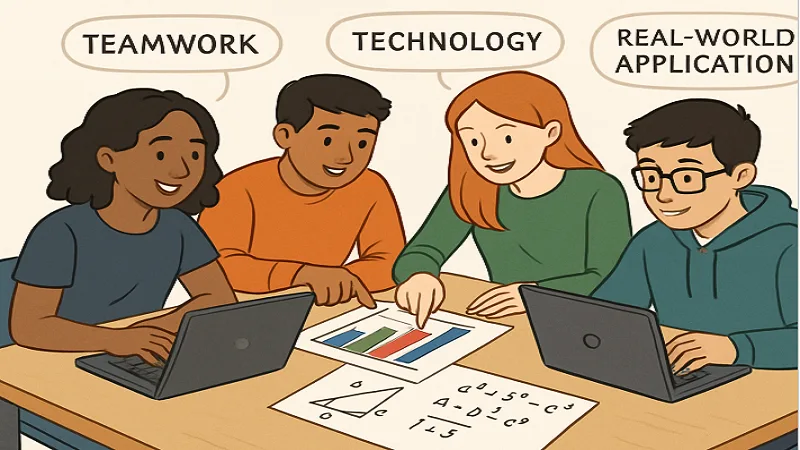
The modern working world is changing more rapidly than ever, and adaptability is highly dependent on a solid mathematical basis. With the incorporation of new digital tools, automation, and data analytics in industries, employees should have the capacity to comprehend information and address complex issues. Math education is evolving into a future-oriented approach that enables learners to acquire analytical, digital, and collaborative skills, preparing them for career paths of a dynamic nature. As an illustration, mathematics secondary education includes real-world learning strategies, which enable learners to think critically and use the knowledge in career-oriented and practical real-life situations. Project-based assessment to open-ended investigation, students are more likely to be exposed to the relationship between mathematical theory and real-life, thus getting to know the importance of math in different sectors.
The new math programs are not about the old number rote anymore; students are taught the aspects of data literacy and collaboration, and problem-solving in immersive learning experiences, which captures their attention. In modern schools, students will probably face both a group project that impresses them with the features of a workplace and assignments that involve using technologies that will expose them to the existing and applicable tools and software used at work. The skills are not only related to better academic achievements but are also directly related to workplace readiness in a field ranging from finance to healthcare to technology. Critical thinking, transferring mathematical justification, and learning to operate in new applications an essential qualities that a person might wish to achieve to be well prepared to work in a flexible and rapidly changing labor market.
Incorporation of Practical Applications
Relating what is studied in the classroom to real-life scenarios is life-changing to the students. Students can tangibly perceive the value of their studies when the teaching of math actively demonstrates how to model budgeting or analysis of risks, or how to interpret statistical trends in sports and media. The experiences have proven mathematics to be more than an abstract subject; they have also shown how problem-solving and analysis can make a difference in investments, personal decisions, and even policies for the masses. Real-life examples promote interest, as well as allow learners to imagine that math is a necessity, regardless of their future career. As an analysis conducted by Education Week reveals, by employing real-world issues, the interest in math may be triggered, and the range of professions will be open to a diverse range of people. Integrating real-life problems into the curriculum not only enables the learning of content but also makes the students build confidence in their ability to use mathematical reasoning outside of the classroom environment.
With the assistance of simulations, role-playing, and problem exploration of issues concerning current events or the direction of future trends, students are provided with an understanding of how math may resolve real problems. As an example, a class project, such as the design of a sustainable city block might also incorporate geometry, statistics and analysis of the budget to meet its objectives in reaching its objectives. Such relevant math education is a foundation for the students viewing any career with interest and a problem-solving attitude.
Emphasizing Data Literacy
The digital economy is founded on the technology of collecting, processing, and using data to make decisions. Math training in the future will also make them data-literate, so that they feel comfortable reading charts, pivot tables, and analytics dashboards. Data skills will always be required, regardless of the future goals of students striving to get jobs in the health care sector, marketing, technology, or science sectors. Curriculum offering high amounts of data analysis provides an advantage to learners, as they are prepared to work in a job where data-based observations will be essential. Since the decisions in most industries are grounded on metrics and predictive analytics, knowledge on how to interpret, question, and visualize data makes it a basis.
These competencies will be developed at an early age so that students can learn about concepts like probability, statistics, and real-time data modeling, which are some of the most rapidly expanding requirements in many careers. The use of datasets in lessons is common to allow students to train in analysis, make predictions, or come up with models. The Brookings Institution study indicates the current need for data literacy in K-12 education to prepare the workforce. Beyond ensuring math achievement, the ability to process and analyze information would enable the student to become an active, informed citizen who is able to appraise and critique the mountain of information they daily receive with a critical eye.
Promoting Learner-Centered Learning
Successful professionals are characterised by their capacity to collaborate in different teams. This fact can be seen in modern math classrooms through collaborative learning, where emphasis is placed on discussion and group solving of problems. Engaging in projects, challenges, as well as presentations, students, in addition to improving their mathematical fluency, also acquire important soft skills, including the ability to negotiate and communicate effectively. The math room provides the opportunity to build interpersonal relationships, leadership skills, and respectful argumentation-the qualities to be used not only in schools but also in the workplace.
Activities where there exists group work allow learners to value the multiplicity of viewpoints and learn from one another, which are among the characteristics of high-functioning teams in contemporary industries. The consensus-building or rotating leaders is also a better idea than having teachers design lessons; both of these need to be part of most modern professions. With an increasing number of companies embracing collaborative forms, students who have such skills are in a definite position not only to get employment but to succeed in highly intricate team-based setups.
The Use of Technology in Math Education
Incorporation of technology equips students with the current demands of the digital environment in modern workplaces. Graphing calculators, online simulations, interactive software, and adaptive platforms allow students to follow their own learning paths, receive personal feedback, and go beyond conventional methods of textbooks. These tools build digital fluency, which trains students on how to use and take advantage of technology, which is a necessity in the majority of modern careers. With the ability to comfortably use the technologies in education, the students will be able to use more educational technologies and learn on their own as professionals.
Differentiation instruction is also made possible by using educational technology, which helps cater to more learners and allows all students to learn the essential mathematical concepts at their own pace. The online community can also offer customized struggles, allow learning outside the school walls, and create a sense of ownership in students towards their math learning. Technology merges with teaching and enables the teacher to not only make learning more interactive, the teacher also provides the students with the skills necessary to make them competitive amidst the fast pace of technology.
Critical Thinking and Problem-Solving Skills
Critical thinking and creative problem-solving are also some of the skills that employers consider to be the most valuable in the workforce. The problem-solving math education model focuses on tasks associated with complex problems instead of the mere memorization of information, which encourages and promotes experimentation, conjecturing, and creating logical arguments in the students. Teachers develop resilience, innovative thinking, and strategizing by setting students the task of finding ways to solve the difficult problems without already having the solutions to those problems. It motivates flexibility and is key to succeeding in an unstable career environment through encountering non-routine challenges.
In this way, the students would be more prepared to solve new problems, become innovative, and make significant contributions in any workplace they may choose to work. When learners are taught how to continue with disappointments while in math class and how to think outside the box, the same behavior becomes applied to their workplace situations, where they are required to be flexible and be able to think on their own.
Preparing for STEM Careers
Math is the foundation of science, technology, engineering, and mathematics (STEM) fields, which are rapidly growing exponentially. Calculus, algebra, and reasoning of statistics are the important principles of computer science, laboratory studies, and modern engineering solutions. To be successful in STEM, one needs a strong background in math, which provides an opportunity to become a software developer or a biomedical researcher, or a high-tech manufacturer. In a world that is becoming more technical in the industry, mathematical understanding in the process of operation can be the differentiator of the most competitive candidates in the job market.
Students who learn modern and future-oriented math are ready to meet the needs of technologically oriented STEM jobs in which technical expertise and analytical skills are vital. They get exposed to the same tools that professionals are using, with access to coding, modeling, and statistical software. Educators help not only with individual career development but also with economic competitiveness on a larger scale, making the world more innovative by guaranteeing that graduates have sufficient preparation to work on a super-specialized level and cope with labor shortages in the sphere.
Conclusion
Modern math education can be considered a vital investment in the labor market and lifestyle empowerment. Relating math, making it collaborative, technology-intensive, and rooted in real-life applications, teachers give the students the stepping stones that they require to have permanent success in careers in the 21st century. Finally, the importance of these changes in education means that a new generation of students is able not only to join the job market but also to become the driving force behind its development in the future. See more